
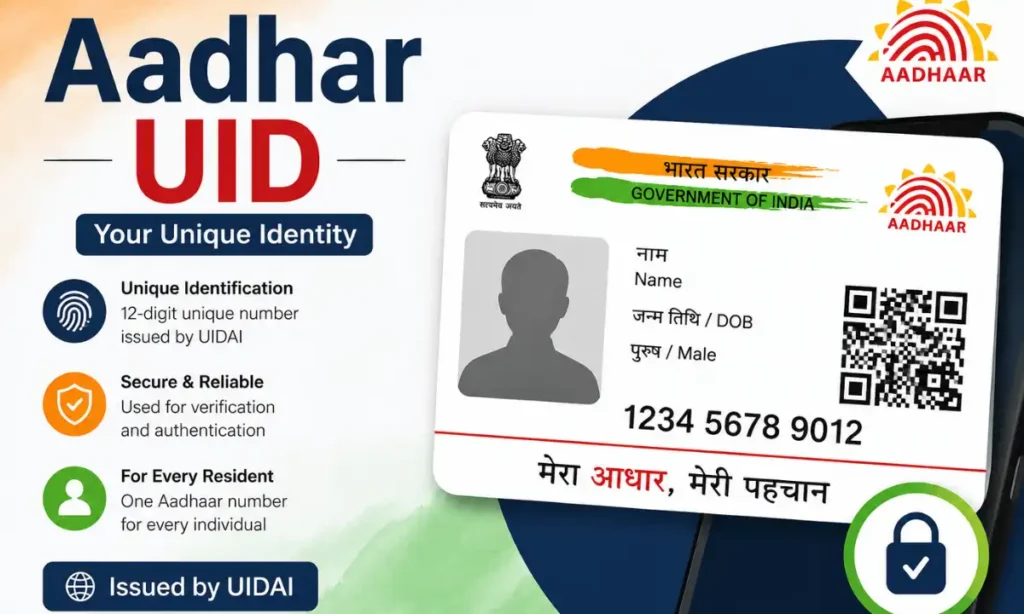
The Aadhaar UID is India’s national digital identity system, managed by the Unique Identification Authority of India (UIDAI). It is a unique 12-digit random identification number issued to residents based on their demographic and biometric data (fingerprints and iris scans). Designed to serve as a universal proof of identity and address, Aadhaar acts as the cornerstone of India’s Digital Public Infrastructure, streamlining governance, enabling seamless digital verification, and driving financial and social inclusion nationwide.
What Is Aadhar UID?
Aadhaar UID is the national digital identity of India which has been set up by the Unique Identification Authority of India (UIDAI). This is a 12 digit randomized number that has been assigned to Indian residents according to their demographics and biometrics. The purpose of this scheme is to act as universal proof of identity and address, making it the bedrock of the Digital Public Infrastructure of India.
What Is the Aadhaar Number?
The Aadhaar number is a 12-digit identification number issued by UIDAI. It is generally printed on the Aadhaar letter or displayed on an e-Aadhaar document. A person normally receives only one Aadhaar number. If someone has questions about their Aadhaar number, they should use official UIDAI services instead of relying on unknown websites or third-party applications.
Who Issues the Aadhar UID?
The Aadhaar UID is issued by the Unique Identification Authority of India (UIDAI), which is a statutory authority established under the Ministry of Electronics and Information Technology (MeitY) by the Government of India.
What Information Is Connected With Aadhaar?
Aadhaar enrolment involves demographic and biometric information. Depending on the applicable Aadhaar process, information may include:
- Name
- Date of birth or age
- Gender
- Address
- Photograph
- Fingerprints
- Iris information
- Mobile number and email, where provided
How to Find Your Aadhar UID Number?
If you have forgotten your Aadhaar number, you should use the official UIDAI service for retrieving or checking your Aadhaar details.
A typical process may involve:
- Visit the official UIDAI website.
- Open the relevant Aadhaar number retrieval service.
- Enter the information requested by UIDAI.
- Complete the verification process.
- Follow the instructions provided on the official portal.
How to Check Aadhaar Status?
To check the status of your Aadhaar application or update request, visit the official Unique Identification Authority of India (UIDAI) website and navigate to the “Check Aadhaar Status” section under the My Aadhaar tab. Enter the Enrolment ID (EID), Service Request Number (SRN), or Update Request Number (URN) provided on your acknowledgment slip, along with the captcha code. Submit the details to instantly view the real-time processing stage of your Aadhaar card.
What Is UIDAI?
The Unique Identification Authority of India (UIDAI) is a statutory authority established under the Ministry of Electronics and Information Technology (MeitY) by the Government of India in 2016. Its primary mandate is to issue the 12-digit digital identity number to residents, authenticate identities, and operate and manage the core infrastructure and database of the national identification system.
How Does Aadhaar Verification Work?
Aadhaar verification is used to confirm whether the identity information submitted by a person matches the information available in the Aadhaar system. Depending on the service, verification may involve demographic information, an OTP, or biometric authentication. The method used depends on the particular Aadhaar service and the organisation requesting verification.
Is Aadhar UID the Same as Aadhaar Number?
Yes, in everyday usage, people often use Aadhar UID or UID number to refer to their Aadhaar number. The standard term is simply Aadhaar number, which is a 12-digit number issued by UIDAI. However, users should be careful when entering their number online because Aadhaar is sensitive personal information.
How to Keep Your Aadhaar Number Safe?
Aadhaar details should be handled carefully because they contain important identity information. A few simple precautions can help:
- Do not share your Aadhaar number publicly on social media.
- Avoid uploading Aadhaar documents to unknown websites.
- Do not send Aadhaar details to suspicious individuals.
- Use official UIDAI services whenever possible.
- Check the website address carefully before entering personal information.
- Use additional privacy options, such as masked Aadhaar, when appropriate.
What Is Masked Aadhaar?
A Masked Aadhaar is an officially recognized, secure digital version of your identity document where the first 8 digits of the 12-digit identification number are replaced with characters like “XXXX-XXXX” or “2XXX-4XXX”, leaving only the last 4 digits visible. Introduced by the Unique Identification Authority of India (UIDAI), it is designed to protect user privacy during third-party verification processes, preventing your complete identification number from being exposed or misused while still confirming your valid identity.
Can You Download e-Aadhaar Online?
Yes, you can easily download a digital version of your identity card online through the official Unique Identification Authority of India (UIDAI) website or the mAadhaar mobile app. By logging in using your 12-digit identification reference or Enrolment ID along with an OTP sent to your registered mobile number, you can securely download a password-protected, digitally signed PDF copy (e-Aadhaar) that is legally valid for all verification purposes across the country.
Difference Between Aadhaar UID and VID
| Term | Meaning |
|---|---|
| Aadhaar Number | The 12-digit number issued by UIDAI |
| UID | A term commonly used for the unique identification associated with Aadhaar |
| VID | A temporary, revocable 16-digit virtual number that can be used in place of Aadhaar number for certain authentication purposes |
| UIDAI | Authority responsible for the Aadhaar system |
Why Is Aadhar UID Important?
The Aadhaar UID serves as the foundational pillar of India’s digital public infrastructure, providing a secure, universally recognized identity to over a billion residents. Its primary importance lies in bridging the gap between citizens and essential services by streamlining Direct Benefit Transfers (DBT), eliminating middlemen, and curbing bureaucratic corruption. Furthermore, it drives financial inclusion through instant e-KYC verification, empowering unbanked populations to access formal banking, credit, and government subsidies with unprecedented ease, transparency, and efficiency.
Common Problems Related to Aadhar UID
People may face several common Aadhaar-related issues, such as:
- Forgetting their Aadhaar number
- Mobile number not being linked or updated
- Problems downloading e-Aadhaar
- Delays in an update request
- Authentication failures
- Incorrect personal information
- Difficulty accessing Aadhaar services
Aadhar UID vs Other Identity Documents
When evaluating India’s Aadhaar UID against traditional identification documents (such as PAN cards, Voter IDs, or Passports), the core differentiator lies in its function as a demographic-independent digital verification tool.
Traditional IDs typically tie verification to specific attributes: a PAN card connects to financial and tax history, a Driver’s License validates driving eligibility, and a Passport establishes citizenship and international travel rights. In contrast, Aadhaar serves purely as a decentralized foundational proof of identity and residence. It does not replace these functional documents; rather, it acts as an underlying universal verification layer that simplifies authentication across them all, eliminating the need for physical paperwork while maintaining absolute randomness without socio-economic profiling.
Conclusion
The Aadhaar UID is much more than just a 12-digit number; it is the foundational pillar of India’s digital public infrastructure. By bridging the gap between citizens and essential services, it has fostered transparency, empowerment, and efficiency. As India continues its journey toward a fully digitized economy, the role of Aadhaar in ensuring secure and seamless identification remains more vital than ever.
Frequently Asked Questions
What is Aadhar UID?
Aadhar UID commonly refers to the Aadhaar Unique Identification Number, generally meaning the 12-digit Aadhaar number issued by UIDAI.
How many digits are in an Aadhaar number?
An Aadhaar number contains 12 digits.
Who issues the Aadhaar UID?
Aadhaar numbers are issued by the Unique Identification Authority of India (UIDAI).
Can I find my Aadhaar number online?
Yes, Aadhaar holders can use the official UIDAI services to retrieve or access their Aadhaar details after completing the required verification.
Is UID and Aadhaar number the same?
The terms are often used interchangeably in everyday searches, although Aadhaar number is the standard term for the 12-digit number issued to an Aadhaar holder.
What should I do if I forget my Aadhaar number?
Use the official UIDAI Aadhaar number retrieval facility and follow the verification process provided there.
Also read about: AS Gaming UID: Free Fire ID, Real Name, Stats, Career and More